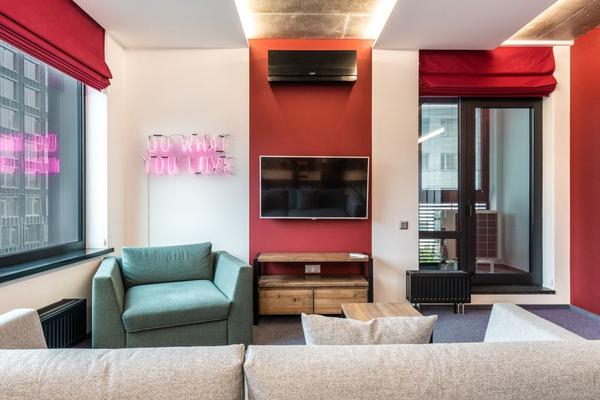
A TV can look enormous in a showroom and surprisingly modest once it is across the room from your sofa. That is why the answer to “what size TV do I need?” starts with where you sit, not the length of your wall. A comfortable screen makes films, sport and games engaging without forcing you to scan from side to side.
Use viewing distance for TV as your starting point, then check the furniture, the content you watch and the space available for the television itself.
Quick TV Size Guide by Viewing Distance
For everyday mixed viewing, these are useful starting points: at about 5–6 feet, consider 40–50 inches; at 6–8 feet, look at 50–65 inches; at 8–10 feet, consider 60–75 inches; and at 10–12 feet, explore 75–85 inches.
These are flexible ranges, not strict limits. Someone who mainly watches the news may prefer a smaller screen than a film enthusiast at the same distance. Your ideal TV size should feel natural from your usual seat.
Calculate TV Size From Your Seating Position
Measure from your eyes when seated to the planned screen position, not from one wall to the other. A deep sofa, TV stand or wall bracket changes the real viewing distance.
Use the 30-degree rule
A common recommendation for mixed viewing is a picture occupying roughly 30 degrees of your field of view. For a typical 16:9 TV, divide the seating distance in inches by about 1.6 to estimate its diagonal size. Treat the answer as a starting point.
Suppose your eyes are 8 feet from the screen. That is 96 inches; dividing by 1.6 gives about 60 inches. A 55-inch set offers a more relaxed experience, while 65 inches feels more immersive. Both deserve consideration.
Go larger for films and immersive games
Some viewers prefer a wider field of view, around 40 degrees, for cinematic content. A 65-inch television at approximately 6.5 feet creates that more involving effect. A TV screen size calculator may offer both 30-degree and 40-degree settings. Choose according to how you watch, not because one number is universally correct.
Choose a TV Size for Each Room
Living room
For a main sofa around 7–9 feet away, 55–65 inches is often a practical shortlist. With seating 10–12 feet away, 75–85 inches may be appropriate. If the room includes chairs at several distances, favor the seats used most often rather than the farthest corner.
Daylight matters too. A large glossy panel directly opposite a window may be less enjoyable than a slightly smaller TV in a position with fewer reflections.
Bedroom
Many bedrooms suit 43–55 inches, but measure from your pillow rather than the foot of the bed. Think carefully about screen height: mounting a television too high can create an uncomfortable viewing angle. Plan the position before drilling and consult a TV mounting height guide for practical placement advice.
Kitchen or compact room
For occasional viewing while preparing meals, 32–43 inches may be enough. You are likely to move around rather than watch from one fixed seat, so visibility and placement matter more than cinema-style immersion. Keep the TV away from splashes and heat, follow installation clearances and avoid blocking cabinet doors.
Media room or gaming space
At around 8–10 feet, 65–85 inches can work for dedicated entertainment, depending on how immersive you want the picture. For gaming, check that you can comfortably see on-screen indicators at the edges. Refresh-rate support, input lag and the viewing angle also matter.
How 4K Resolution Affects Your Choice
A 4K television packs more pixels into the screen than a similarly sized Full HD model. Individual pixels are therefore harder to notice at close distances, giving you more flexibility to choose a larger picture.
However, the source still matters. Older television broadcasts and heavily compressed streams can appear soft on a very large 4K screen. If you mostly watch low-resolution programmes, a slightly smaller set may be preferable. For more detail, read a 4K vs 1080p TV guide before comparing models.
Measure the Screen’s Real Width
TV sizes refer to the visible screen’s diagonal, not its width. For a standard 16:9 display, a 55-inch screen is approximately 48 inches wide, a 65-inch screen about 57 inches, and a 75-inch screen about 65 inches. Frames, stands and feet can add to those measurements, so check the actual product specifications.
Before purchasing, mark the proposed screen dimensions on your wall with low-tack painter’s tape. Sit where you normally watch and look toward all four corners. Compare two sizes this way: the outline makes a much more useful impression than a tape measure held diagonally.
Also check whether the stand fits securely, a soundbar has room and nearby doors can open. If wall mounting, confirm the bracket’s weight rating and mounting pattern, and leave the required ventilation and cable space.
Three Mistakes That Lead to the Wrong Size
First, choosing by floor area alone overlooks seating layout. Two identical rooms can need different screens if one sofa sits much closer to the television.
Second, confusing a minimum distance for seeing 4K pixels with the distance that feels comfortable can produce an excessively large screen. Image sharpness and a pleasant viewing angle are different concerns.
Third, spending the entire budget on screen size may mean compromising on contrast, reflections or motion performance. A good 65-inch model can be more satisfying than a weaker 75-inch one. An OLED vs QLED TV comparison can help when evaluating picture technology.
Frequently Asked Questions
Is a 65-inch TV too big for a small living room?
Not automatically. At roughly 7–9 feet from the main seat, 65 inches can work comfortably if the wall or furniture can accommodate it. Measure the actual distance instead of judging the room’s size.
What size TV should I get for 8 feet?
Start by comparing 55-inch and 65-inch models. The former feels more restrained, while the latter gives films and games greater impact. Neither is the only correct choice.
How is TV screen size measured?
The advertised measurement runs diagonally across the visible screen from one corner to its opposite, excluding the surrounding frame. It is not the width of the television.
Should I buy the biggest TV that fits?
Only if it also suits your seating distance, viewing preferences and budget. Physical fit alone does not guarantee comfortable watching or strong picture quality.
Make Your Final Choice in the Room
Measure from your eyes to the planned screen, shortlist two neighboring sizes and mark their outlines on the wall. A useful tv size guide can narrow your options, but the view from your own sofa decides which feels right. Once the dimensions work, compare picture quality and features with confidence.