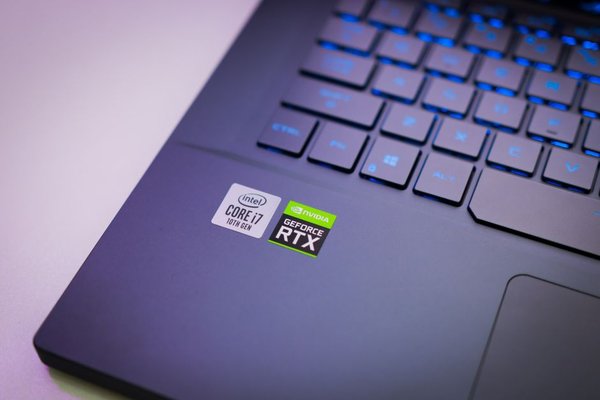
If you already own an RTX 4070 gaming laptop, the RTX 5070 Laptop GPU is a more complicated upgrade than the model number suggests. Both sit in the same broad performance class and can handle strong 1080p and 1440p gaming. The real question in 2026 is whether Blackwell features, newer memory and a better-designed laptop justify replacing a machine that may still be perfectly capable.
RTX 5070 vs RTX 4070 Laptop GPU: key differences
NVIDIA lists 4,608 CUDA cores for both the RTX 5070 Laptop GPU and RTX 4070 Laptop GPU, so the newer part does not simply win by having far more shader hardware. The RTX 5070 uses Blackwell with fourth-generation ray-tracing cores and fifth-generation Tensor cores, while the RTX 4070 uses Ada Lovelace with third-generation RT cores and fourth-generation Tensor cores.
Memory changes from 8GB GDDR6 on the RTX 4070 to 8GB GDDR7 on the RTX 5070, with both using a 128-bit interface. Faster memory helps the 5070, but the capacity remains 8GB. In demanding games, especially with high-resolution textures or heavy ray tracing, VRAM can still become a limitation before raw GPU speed does.
Power limits can change the result
A gaming GPU comparison on laptops is unusually sensitive to power limits. NVIDIA specifies the RTX 5070 Laptop GPU across roughly 50W to 100W of GPU subsystem power, while the RTX 4070 Laptop GPU spans roughly 35W to 115W. Manufacturers can therefore tune the same GPU name very differently depending on chassis size, cooling and product positioning.
This creates a buying trap: a well-cooled, higher-power RTX 4070 laptop can compete surprisingly well with a lower-power RTX 5070 design in conventional gaming. An RTX 5070 laptop benchmark is most useful when you also check the exact laptop model, GPU power target, CPU, cooling system and display resolution.
A practical upgrade scenario
Suppose you own a 2024 RTX 4070 laptop that sustains high GPU power without serious throttling. Replacing it with an ultra-thin RTX 5070 model may add newer features without feeling dramatically faster in every game. Moving from a hot, restricted RTX 4070 chassis to a well-cooled RTX 5070 laptop can be much more noticeable because you are improving the complete system, not just the GPU generation.
Gaming performance: native frames versus generated frames
In traditional rendering, the gap varies by laptop design and game rather than following one fixed percentage. The RTX 5070 benefits from architectural updates and GDDR7 memory, but the shared 4,608 CUDA-core count helps explain why the raw generational leap may look moderate in some titles.
The bigger distinction is NVIDIA’s newer AI feature set. RTX 50-series laptops support DLSS 4.5 features including Multi Frame Generation and Dynamic Multi Frame Generation, while RTX 40-series laptops support standard Frame Generation but not Multi Frame Generation. In compatible, graphically demanding games, that can make the RTX 5070 display substantially higher frame rates.
Generated frames are not the same as an equal increase in native rendering speed. Competitive players should still care about base frame rate and latency. For visually demanding single-player games, however, the RTX 5070’s newer DLSS capabilities can be a meaningful advantage.
Thermals, noise and efficiency
The GPU badge alone cannot tell you which laptop will run cooler or quieter. Cooling design, fan curves, CPU power sharing and chassis thickness matter enormously. A thick RTX 4070 laptop with large fans may operate more comfortably than a compact RTX 5070 laptop pushed near its thermal limits.
When reading an RTX 4070 laptop review or comparing it with a 5070 model, look for sustained gaming temperatures, fan noise and long-duration clock behaviour rather than a short peak benchmark. Consistent performance after an hour of gaming matters more than winning a brief test.
Does 8GB VRAM reduce the upgrade value?
For many 1080p and 1440p games, 8GB remains workable when settings are chosen sensibly. The concern is longevity at the upper end. Newer games can put heavy pressure on VRAM when high-resolution textures, path tracing and higher output resolutions are combined. Since both GPUs have 8GB, moving from a 4070 to a 5070 does not provide extra memory headroom.
If your main reason for upgrading is that your RTX 4070 laptop is already hitting VRAM limits, the RTX 5070 may not solve the problem you actually have. A higher-tier GPU with more VRAM could be the smarter target.
Price decides whether the upgrade makes sense
By 2026, RTX 4070 laptops may appear at clearance or used-market prices, while RTX 5070 systems are newer and often bundled with newer CPUs, displays and connectivity. The useful comparison is therefore the price of the whole laptop, not the GPU alone.
If two otherwise similar machines are close in price, the RTX 5070 is generally the better long-term choice because of Blackwell, GDDR7 and newer DLSS capabilities. If the RTX 4070 machine is substantially cheaper, it can still offer strong value for 1080p or 1440p gaming. Related internal reading could include a gaming laptop buying guide, laptop cooling guide and GPU performance guide.
Who should upgrade?
Upgrading makes the most sense if you want Multi Frame Generation, you are replacing an older or poorly cooled chassis, or the new machine also delivers a noticeably better CPU, display, battery life or build quality. It makes less sense if your current RTX 4070 already meets your frame-rate targets and your only expectation is a dramatic jump in native GPU performance.
Frequently asked questions
Is the RTX 5070 Laptop GPU much faster than the RTX 4070 Laptop GPU?
Not necessarily in every game. Performance depends heavily on each laptop’s power limit and cooling. The RTX 5070 has newer architecture, faster GDDR7 memory and newer AI features, but both GPUs have 4,608 CUDA cores and 8GB of VRAM.
Does the RTX 5070 Laptop GPU have more VRAM?
No. NVIDIA specifies 8GB for both. The RTX 5070 uses GDDR7, while the RTX 4070 uses GDDR6.
Is Multi Frame Generation a reason to choose the RTX 5070?
It can be if you play supported, graphically demanding games. Multi Frame Generation is an RTX 50-series capability and can greatly increase displayed frame rates, though native performance and latency still matter.
Should I buy a discounted RTX 4070 laptop in 2026?
Yes, if the discount is meaningful and the laptop has a strong cooling design, suitable display and good power configuration. The RTX 5070 becomes more compelling when the price gap is small or its newer DLSS features matter to you.
Final verdict
The RTX 5070 Laptop GPU is the more modern option, but it is not an automatic must-buy upgrade for every RTX 4070 owner. Its strongest advantages are Blackwell architecture, GDDR7 memory and newer DLSS features, while the unchanged 8GB VRAM capacity keeps expectations in check. If your current 4070 machine performs well, keep it unless the new laptop improves several parts of the experience. If you are buying from scratch and prices are close, the RTX 5070 is the stronger choice.